
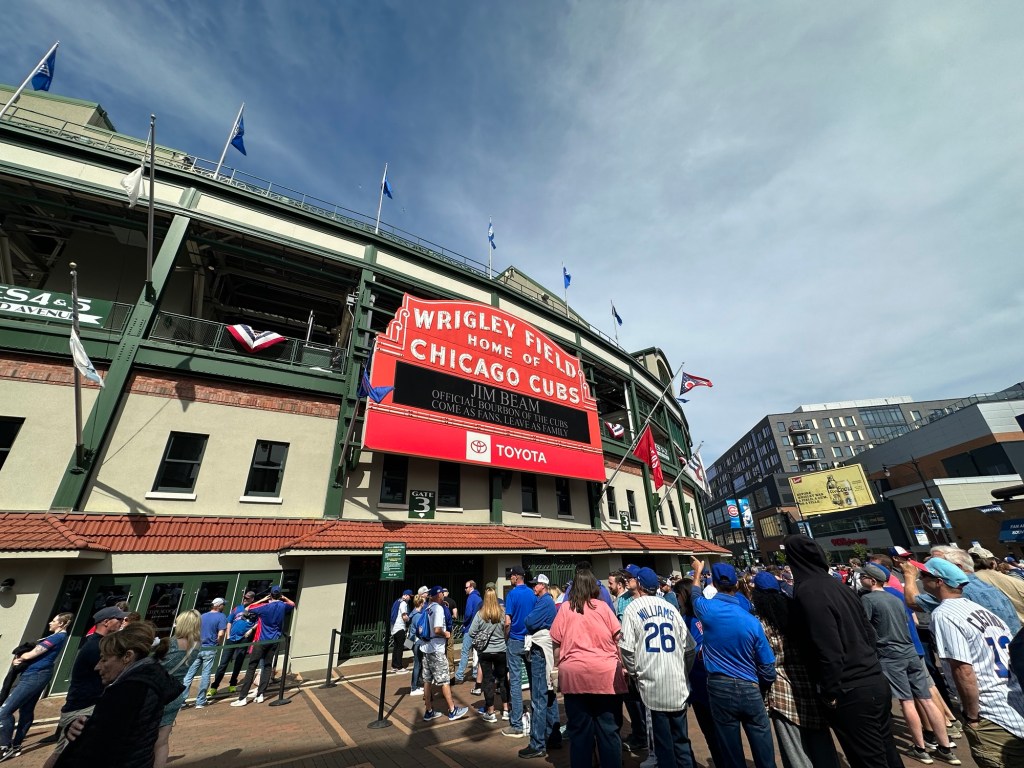
Visit Date: May 27, 2023
The majestic Wrigley Field, the Friendly Confines. The charm and the legacy that comes with each passing game, each and every season. You can’t discuss the history of baseball, nor the history of Chicago, without mentioning Wrigley Field. This stadium, even with all its renovations in the 2010s, still makes you feel like you’re stepping back in time to its first season more than a century ago.
There are few, if any, better places to watch America’s pastime than on Chicago’s North Side. Opened in 1914, the Cubs have called it home since the 1916 season. The team has famously only won a single World Series title in that time and, of course, there’s a legacy steeped in superstition and curses to go along with it. However, before you even enter the gates, there is this distinct atmosphere that hovers over Wrigleyville. No, it’s not the smell of Lake Michigan. It’s this feeling that you’ll never truly experience anything like this anywhere else in the world. I’ve never been as excited to attend a baseball game in my life, and as soon as it was over, I immediately began thinking about when I might be back again. Mind you, this was a game between the Cubs and the Cincinnati Reds, two of my least favorite teams in Major League Baseball. So it wasn’t the product on the field that enticed me. It was the perfect mix of ambiance, beauty, and historical significance that left me yearning for more.
When discussing Wrigley Field, it’s difficult to avoid drawing comparisons to Fenway Park in Boston. The latter, being two years older, obviously has its fair share of history and a classic energy to go along with it. But as I’ve already discussed in my Fenway review, there was something missing. Something I still can’t quite put my finger on. But whatever it was, I know Wrigley had it. Ultimately, I think it comes down to the entire gameday experience from the moment you draw near the stadium until well beyond the final pitch when you get in the car or on the train to go home.
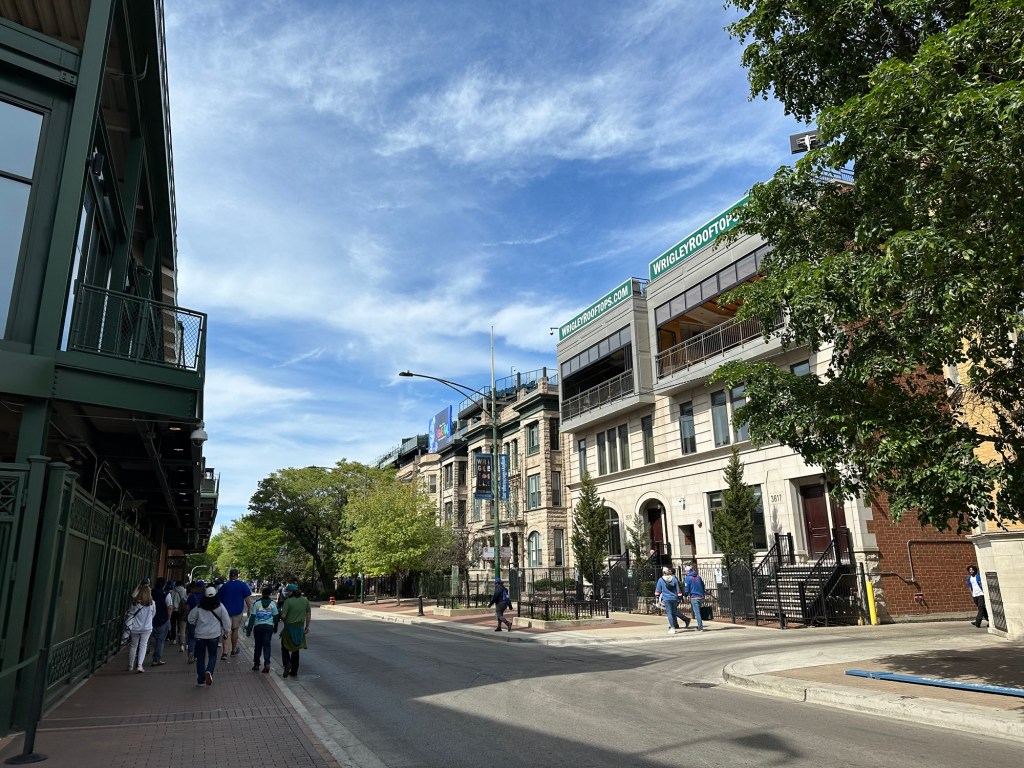
We booked this trip to Chicago for Memorial Day weekend and decided on the Saturday game. Any time we go to a baseball game in another city, we try to avoid booking it for the final day of our trip. That way, in the event of a postponement due to weather, we can try to fit one in on a different day. Luckily for us, that was no issue. We spent the entire day outdoors in comfortable temperatures under partly cloudy skies. After having a late lunch at a conveyor belt sushi restaurant, we walked about a mile to the stadium through the Lakeview neighborhood.
We approached Wrigley Field at its right field entrance at the corner of Addison Street and Sheffield Avenue. I always like to arrive at least an hour before first pitch when I visit a new stadium, and since this one was an even bigger deal than normal, we thought we’d give ourselves a little more time to roam around. Even so, we were there way too early. For a 6:15 start time, we showed up at 3:40. The gates weren’t set to open until 4:15, yet we were far from the only ones taking in the pregame sights and sounds at that point.
Since we had time to kill, we did a lap around the block so we could take in the full environment that surrounds the stadium. Unlike most modern MLB ballparks, Wrigley Field finds itself in the middle of a neighborhood rather than in a downtown setting or surrounded by a sea of parking lots. This reminder of a bygone era, a reminder of how Wrigley has stood the test of time when so many others across the country have been replaced as much as two or three times over, only adds to its charm. While even some iconic places like Yankee Stadium were turned into piles of rubble, the Cubs put their money towards renovations instead. It makes you appreciate the countless fans who have made this same trek for over a century. Stars like Ernie Banks, Ron Santo, Billy Williams, Ryne Sandberg, and Sammy Sosa have come and gone, but through it all, Wrigley remains.
Speaking of which, this was Billy Williams bobblehead night, but they were only giving out 10,000 so folks were already starting to line up by the time we arrived. Williams, whose Hall of Fame career in left field led to his number 26 jersey being retired by the team, was given a bobblehead with a number 1 on the back by mistake. So we ended up getting an email apologizing for the error and offering a replacement at a later date. I didn’t mind much. I was just happy to add another to my ever-growing collection.
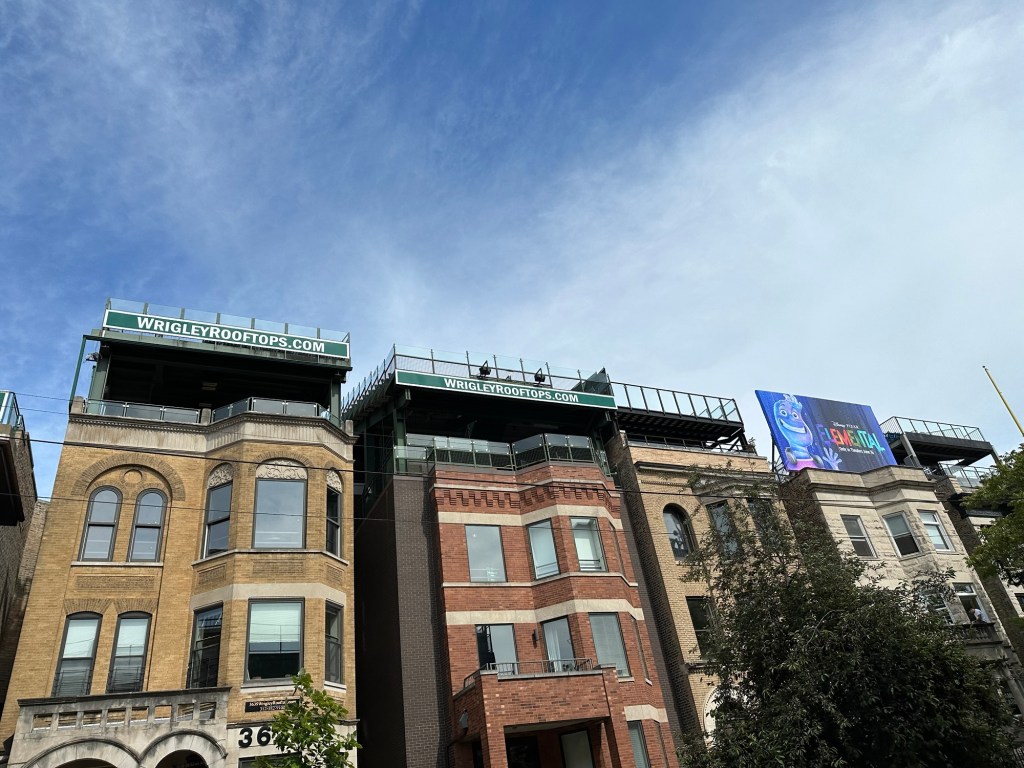
As we were doing our lap before joining the queue, I stopped to admire the Wrigley Rooftops. For those that don’t know, these are bleachers that sit above a dozen buildings along Sheffield and Waveland avenues beyond the confines of the stadium. Tickets here are oftentimes more expensive than to the actual game, and with the addition of large scoreboards in left and right field during the recent renovations, they don’t offer the greatest of views. What a lot of people don’t realize, too, is that the Cubs have bought nearly all of these properties in the past decade, so your money is still going to the team whether you knew it or not. Someday, I hope I’ll get the chance to see a game from this distinct vantage point, but for now, I was happy to even admire it from street-level.
You could tell just how much money the Cubs organization has poured into revitalizing Wrigleyville. They are major trendsetters for the “ballpark district” concept; this is where the team owns most of the surrounding buildings and leases the properties out to restaurants, bars, hotels, housing, and other amenities. On this day (and I’m sure every day), fans were taking full advantage of these offerings. The idea is proven to work, and anytime a new stadium gets proposed, you are bound to see something like this. Teams realize more and more that the gameday experience isn’t just about what happens once you walk through the gate. They want to make their parks feel like a natural part of the greater neighborhood environment.
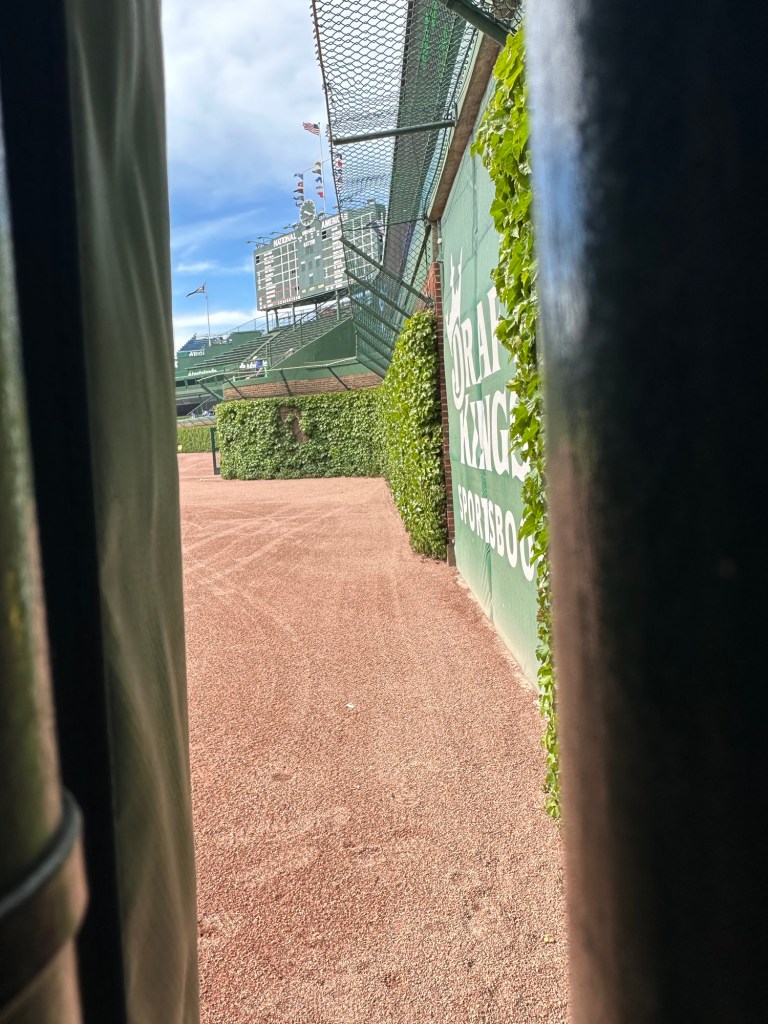
After we stopped to admire the famous red marquee at the home plate entrance, we got in line at the right field gate. Even after a few steps inside, I was instantly in awe. The beautiful ivy-covered wall was just feet in front of me, separated only by a fence. It was almost like I was being beckoned to make my way onto the field and grab a leaf from its vine. Not wanting to get myself kicked out within minutes of walking in, I held back, but it’s hard to resist the allure of this place.

We spent a great deal of time just walking around the stadium to get a feel for it. It was so picturesque that I just kept saying “wow” as we ventured through the stands. As I said before, it was like we took a time machine decades into the past. There’s still a hand-turned scoreboard in straight-away center. Flags adorn the top of it to mark the division standings in the National League. And until 1988, there weren’t even any lights at Wrigley Field to allow for night games. The concourses themselves, while clearly modernized in recent years, lack the sight-lines to the field that you’d see at most ballparks today. Some have been critical of the changes made, and though I can’t comment on how things used to be, I felt they were seamlessly and thoughtfully integrated so as not to take away from the vintage feel.
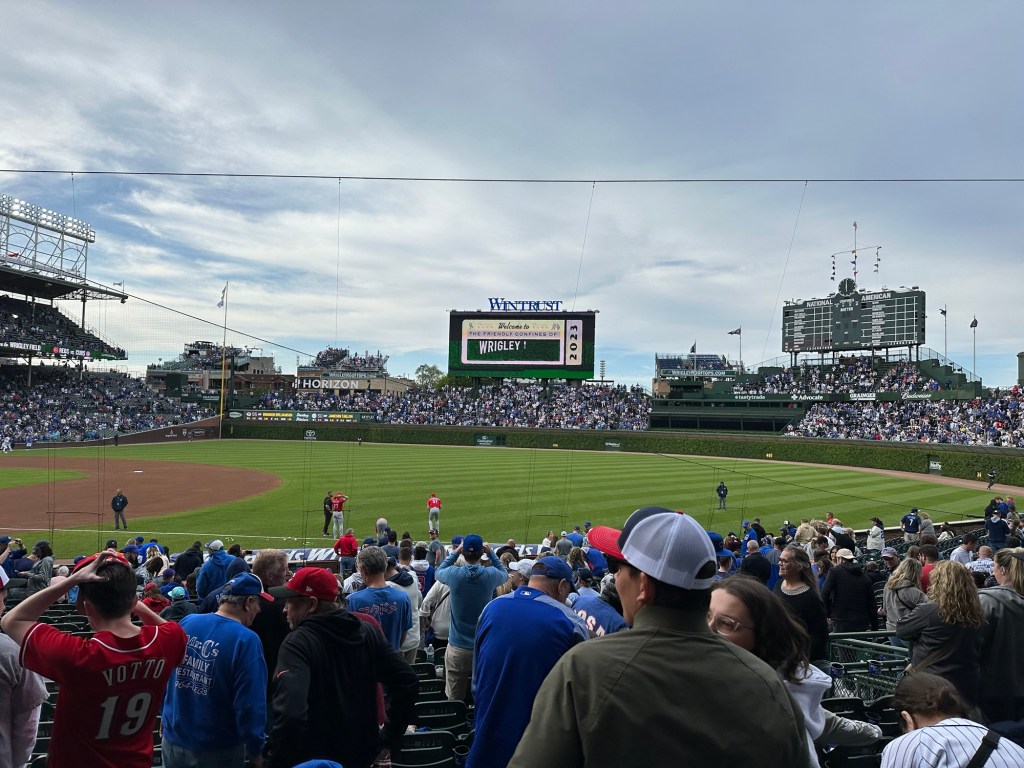
We had great seats along the first base line. I was careful with my selection because, like Fenway, you might accidentally find yourself sitting behind a pole if you sit far enough back on the lower level. You can run into the same issue in the upper deck as well, although it seemed like the seats up there were generally closer to the action on the field than other upper-levels we’ve experienced. One spot that we didn’t get a chance to check out was the outfield bleachers. Given their reputation, I think I’d like to sit here on our next go-around.

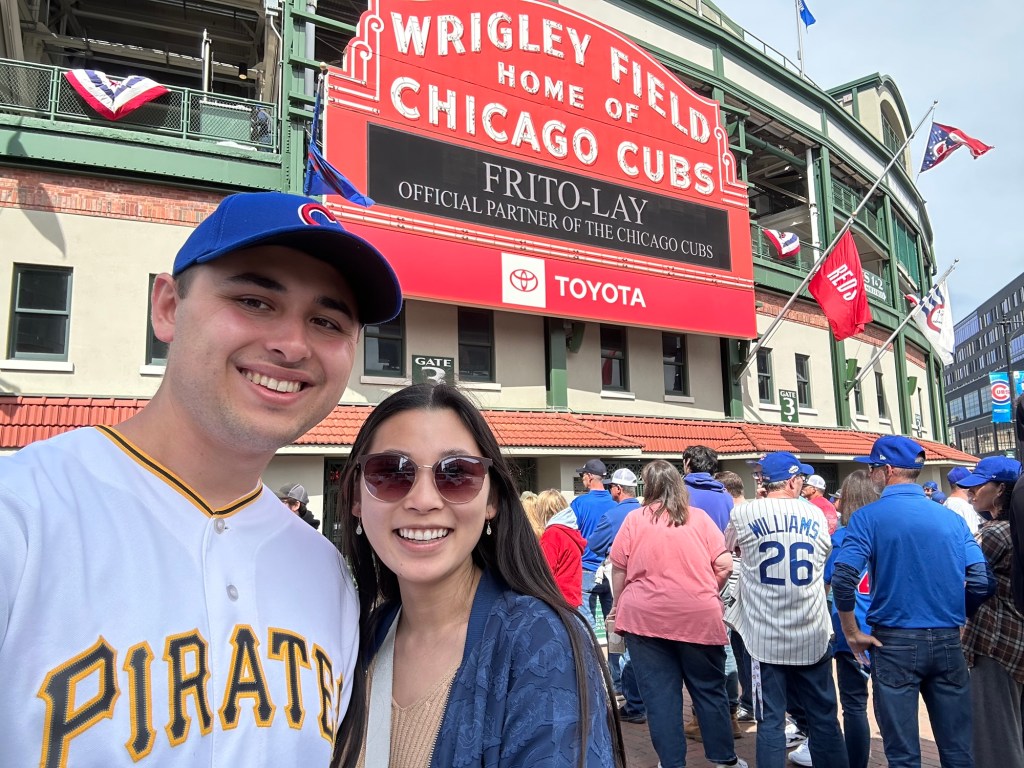
One final thing to highlight is the positive attitudes and overall kindness that was shown to us by the Chicago fans, particularly the ushers. I decided to wear a Pirates jersey to the game even though they weren’t playing, and a couple workers stopped me to chat about what brought us there and to see how I felt it compared to PNC Park back home. While I honestly worried about what the atmosphere would be like, those preconceived notions were quickly thrown out the window. From their renowned hot dog vendors to their famed rendition of “Take Me Out to the Ballgame”, Wrigley Field knows how to put on a show. Even though I don’t find myself in their fan base, the Cubs make you feel like you’re part of a larger community.
There aren’t enough nice things to say about this icon of Chicago’s North Side. When all is said and done, I don’t know exactly where it will fall on my overall stadium rankings, but I don’t see how I can leave it out of the top three. Plenty of people prefer Fenway Park, and that’s perfectly fine. We all are looking for different things when we visit a ballpark. For me, even if Wrigley Field maybe isn’t the greatest all-around stadium in Major League Baseball, it’s the one spot that should be at the top of any baseball fan’s bucket list. You have to see it firsthand to truly understand the mystique. Ever since I walked out the gates on that cool May night, I’ve been ready to book my next trip back to Chicago just so I can do it all again. Having already withstood the past century, I know Wrigley Field will always be there to beckon me back.

WE WANT TO HEAR FROM YOU:
Thank you for checking out the third installment in our MLB Stadium Tour series! You can find all of our previous entries here. Let us know in the comments if you have any questions about Wrigley Field or if you’d like to share your own opinion based on a previous visit. Make sure to comment which stadium you’d like us to cover next!
 Small World Travel Blog
Leave a comment